


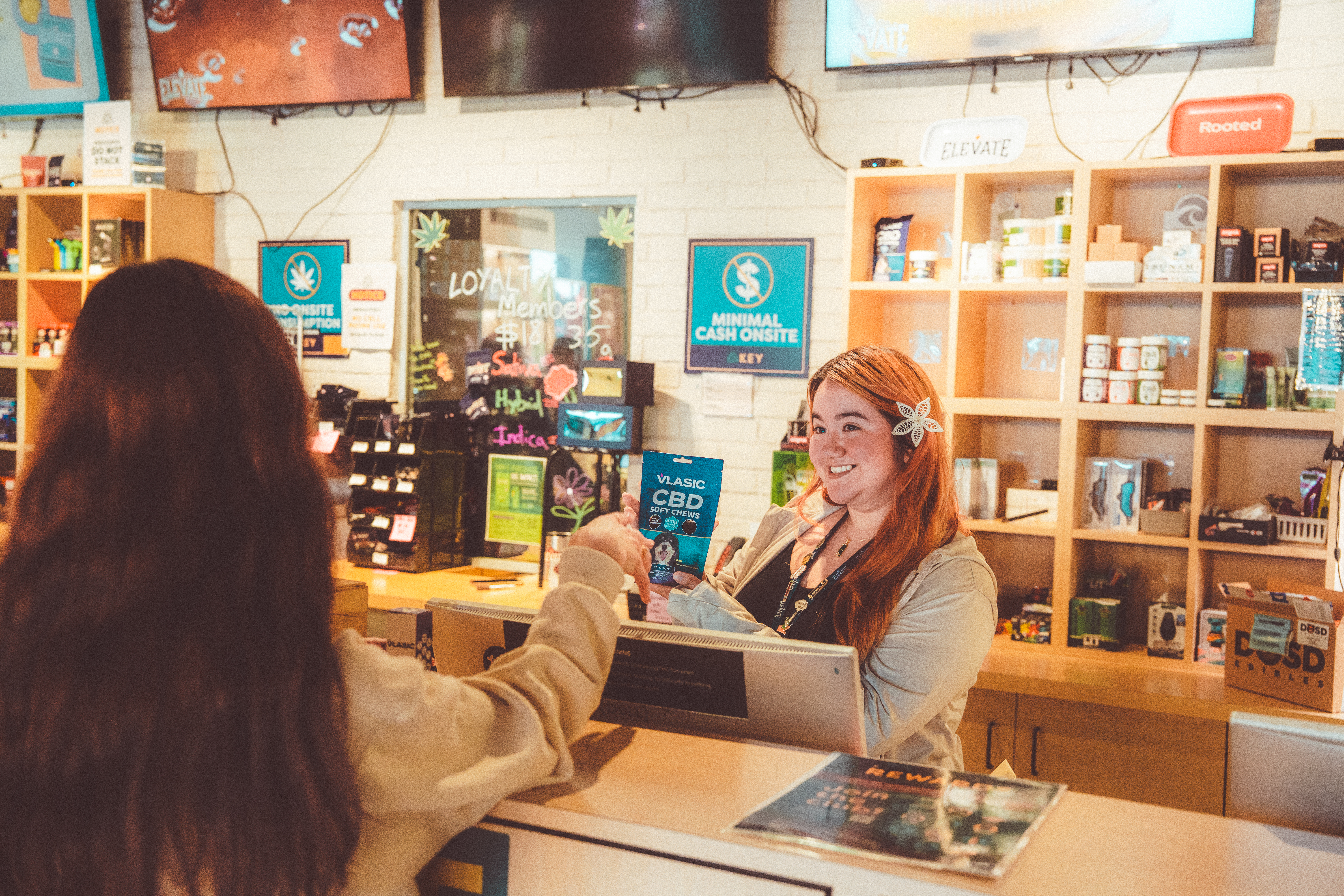
If you’ve ever bought cannabis in Missouri, you’ve probably noticed the tax line on your receipt and wondered what you’re actually paying into. It’s a fair question, and we’d love to provide some answers.
Every dollar spent at a licensed, regulated Missouri dispensary funds veterans’ healthcare, local infrastructure, drug treatment programs, and local infrastructure. Every dollar spent on unregulated hemp-derived products or unregulated weed at a gas station or smoke shop? [shrugging emoji lol]
With Missouri’s unregulated intoxicating hemp market being phased out under new federal law, now is the moment to understand exactly why shopping regulated matters.
Missouri’s Cannabis Program, By the Numbers
In 2025, industry generated $255.57 million in sales tax revenue for state and local governments. Since the first legal medical marijuana sales in October 2020, the program has generated roughly $750 million in sales tax revenue – money that didn’t exist in Missouri’s budget before legalization.
This doesn’t count the millions more the industry pays annually in licensing fees and payroll taxes, or the thousands of jobs created at Missouri-grown, Missouri-owned cultivation and retail operations.
Where the Money Goes
Veteran’s Healthcare
One of the biggest beneficiaries of Missouri’s cannabis tax revenue is the Missouri Veterans Commission. The program has received more than $105.57M since 2023, which goes directly toward healthcare services for veterans in our state.
Public Defenders
Beyond veterans’ care, Missouri’s adult-use marijuana tax revenue directly funds the state’s public defender system – historically one of the most underfunded in the country – to benefit people who can’t afford a private attorney and need legal representation. It’s a small but meaningful example of how legalization funds criminal justice infrastructure that the War on Drugs-era enforcement used to train.
Drug Treatment Programs
Last, but not least by any means, the Missouri Constitution stipulates that Missouri’s adult-use tax revenue be used to fund addiction treatment programs overseen by the Missouri Department of Health and Senior Services. Rather than treating substance use disorders purely as a criminal matter, a portion of every regulated purchase goes toward helping Missourians fighting addiction.
Local Communities
Cities and counties with licensed dispensaries don’t just get economic activity in the area – they get direct tax revenue they can put toward roads, public safety, and community programs. Maxed out at 3%, voters can approve local city or county taxes to be used at the discretion of the municipalities. Often used on law enforcement or general budget needs, local governments have collected nearly $104 million statewide in 2025 alone.
Regulated vs. Unregulated: What’s the Real Difference?
Here’s what actually separates a licensed Missouri dispensary from a gas station or smoke shop selling intoxicating hemp products:
| Licensed Dispensary | Unregulated Retailer | |
| Age Verification | Strictly enforced by licensed staff | Often unenforced |
| Product Testing | Required, monitored lab testing for potency and contaminants | None required |
| Product Source | 100% grown and processed in Missouri (tracked seed to shelf) | Unknown origin |
| Packaging Restrictions | Childproofing strictly enforced; no fruits, animals, or humans allowed in design | No enforcement; Many mimicking candy or characters appealing to children |
| Regulatory Oversight | Missouri Division of Cannabis Regulation | Largely unregulated |
| Tax Contribution | Funds veterans, local gov’t, state programs | Effectively none |
Every dollar spent at a smoke shop selling unregulated hemp products is a dollar that skips all of the above. No testing standards, no dedicated tax structure, no reinvestment in Missouri.
The Hemp Ban: Why It Matters Right Now
In November, Congress passed and the President signed legislation banning intoxicating hemp-derived cannabinoids that exceed 0.3% total THC or 0.4mg of THC per container. That federal law takes effect November 12, 2026, and Missouri lawmakers are already moving to align state law with it through bills like SB 904 and HB 2641.
In practice, this means many of the unregulated shops selling intoxicating hemp products across Missouri are shutting down or will soon have to. For consumers, that’s not a loss, but a shift towards a market that’s actually tested, locally sourced, and accountable.
Shop Regulated. Support Local.
Choosing a licensed Missouri dispensary isn’t just about getting a safer, lab-tested products (though it matters – let’s be real). It’s about where your money goes after you leave the store – towards veterans’ healthcare, local community funding, and a legal industry built entirely on Missouri-grown product and Missouri jobs.
As the regulated hemp market winds down across the state, there’s never been a better time to make the switch to a dispensary you can trust.
Ready to shop regulated? Visit Key Cannabis Dispensary to see what Missouri-grown product actually looks like.


 2601 W Dunlap Ave., Suite 21, Phoenix, AZ 85021
 Mon-Sun 8:00 AM – 10:00 PM
 602-812-2140